Treatment of oily sludge
Jul 04, 2022
Treatment of oily sludge from landing, tank bottom of oil and gas station, oily sludge from sedimentation tank (recovered oil)
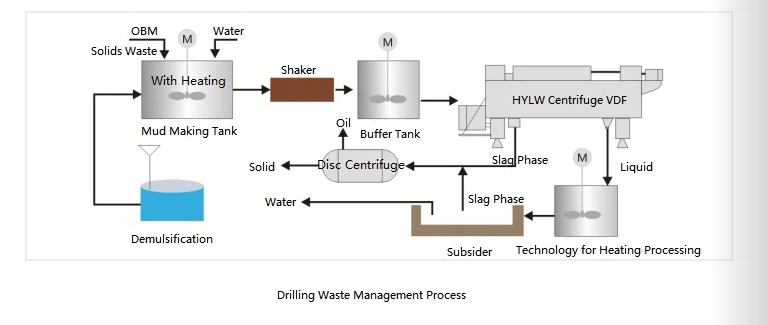
1. The oily (waste) water is collected by heating and adding water so that it is and solid from semi-solid to liquid with a moisture content of more than 60%.
2. Use a vibrating shaker to screen for oil pollution (waste). Remove large particles of soil, sand, glass bottles, mineral water bottles, convenient bags, gauze, and other household garbage and solid waste.
3. Add appropriate demulsifiers, active agents, etc. to emulsify the oil and water in the emulsified state.
4. After demulsification, the oil sludge is continuously separated by liquid phase + slag phase using HYLWS series two-phase centrifuge. The liquid phase is reused after separation by centrifuge, and the slag phase enters the disc centrifuge.
5. The slag phase can be used for refining after further purification by disc centrifuge; Recovery of residual oil, and separated oil can be collected and used as crude oil.
The landing sludge is heated and demulsified, then the shaker is used further to remove the large particles of sand and stone, and then the centrifuge is separated.
Separation performance:
1. 98% of large particles or household waste can be filtered through a vibrating screen.
2. After horizontal screw centrifuge separation, the impurity water content of the oil phase can reach < 3-5%;
3. After centrifuge separation, the dryness of the slag phase can reach 40 ~ 60%, and the total volume is more than 80% less than before separation.
4. Recovered oil can be used for refining and recovery by further purification of disc centrifuge. It can recover more than 96% of oil (related to oil density, demulsification effect, temperature, etc.), and reach the oil containing less than 1% water and solid.
5. The liquid phase of the decanter centrifuge can be recycled to the first part of heating and washing, save water resources, and avoid the need for more equipment and tank storage in the link produced by the liquid phase.