
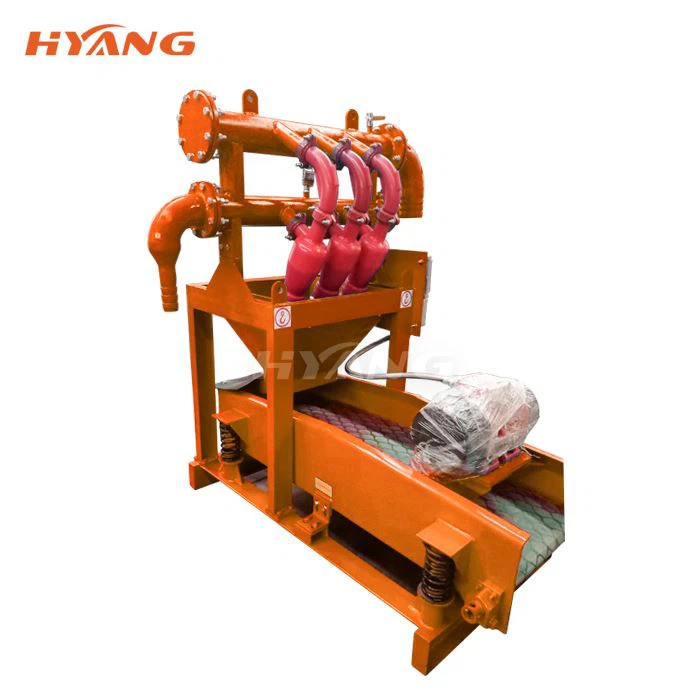
Decanter Centrifuge
A decanter centrifuge, also known as a horizontal bowl centrifuge, solid bowl centrifuge or scroll centrifuge, is a machine used to separate a solid material from a liquid(s) using a high-speed and continual rotational process.
Company Profile
Xi'an Huayang Oil & Gas Equipment Co., Ltd. (HYANG) was established in January of 2017, we are a professional manufacturer of oilfield solid control equipment and oilfield integrated engineering service provider. HYANG has an outstanding team of 30 R&D personnel, 18 management staff, 20 domestic and overseas marketing specialists plus 15 after-sales services, together with advanced equipment, strong technology, excellent product design, and research ability. Our products comply with API standards and have passed the ISO9001 quality management system. They have been adopted by major oil fields in domestic and overseas.
Why Choose Us
Experienced team
HYANG has an outstanding team of 30 R&D personnel, 18 management staff, 20 domestic and overseas marketing specialists plus 15 after-sales services, together with advanced equipment, strong technology, excellent product design, and research ability.
Our product
HYANG mainly works for various solids control equipment and accessories, solids control system, Oil sludge treatment, vacuum absorption environmental toilet, and also mud recycling system used in HDD, TMB, CBM, and boring pipe. And oilfield equipment, energy-saving, and environmental protection products like drilling rig equipment, drilling rig accessories, wellhead devices, high-presifoldsure men, well completion/testing tools.
Quality control
Our products comply with API standards and have passed the ISO9001 quality management system. They have been adopted by major oil fields in domestic and overseas.
Our service
HYANG always persists in the business philosophy of customer-focused service ideas to satisfy customer needs, providing integrity and efficient package solutions for worldwide industrial manufacturers and also timely, transparent, and veritable procurement experience for customers.

Shale shaker is the primary step of the sieving. It can remove over 100um particles when drilling.Drilling rig shakers screen the drilling fluid containing a large number of cuttings, separate large-size solid particles, and send the drilling fluid to the next separation device, our HY series shale shakers have advantages like simple structure, reliable performance, large processing capacity, long service life, and easy maintenance.

1.Compact structure, small volume. 2. Cyclone Material: Polyurethane.
3. Color: Orange, Blue or customized. 4. Treatment capacity: 60~320m³/h (264~1408GPM). 5. Screen Type: Flat Panel. 6. Schneider or Siemens electrical components.

Mud shale shaker is composed of feeding tank, base, screen box, vibration motor, etc. The screen box is supported on the base by six isolation springs, and three identical or different screens are installed on the working surface of the screen box.

Mud gun used to mix drilling fluid in the mud tank to prevent the drilling fluid from settling. Placed on the top of the drilling fluid circulation tank. Quantities are according to the number of mud agitator. Work as tank bottom washing tool when working with mud agitator. Three types of mud guns are available: low pressure, medium pressure and high pressure.

Mud Gas Separator is a special device for the primary degassing for gas-invasion drilling fluids, it's an necessary equipment for drilling deep wells and gas wells.

The steel-wood foundation, also known as the rig mat, is a plate-like equipment composed of wood and steel, and is an outdoor ground decoration equipment similar to floor tiles. It enables drilling workers to perform operations in various complex geographical conditions. For example, when the ground is wet or the land is too unstable during the rainy season, a steel-wood foundation is installed under the land-based oil rig.

Screw conveyors are available horizontal screw conveyors and inclined hopper screw conveyors, which can be used in conjunction with other transportation equipment to complete combined transportation, separate transportation, mixing, deployment, dehydration, compounding, unloading and stacking, etc., screw conveyors length can be customized according to site requirements. In oilfield and environmental protection fields, screw conveyors are mainly used for drilling fluid waste treatment and drill cuttings transportation, which is widely used in mud recycling systems and oily sludge treatment system projects.

1. Separate the liquid from drilling cuttings effectively. 2. High chromium cast iron for discharge scraper to extend equipment lifetime. 3. Special designed high-pressure air knives can effectively prevent the basket from blocking. 4. Each replaceable part is individually balanced for future replacement. 5. Independent oil lubrication & oil tank cooling system meet high temperature needs. 6. Able to separate and dry different kinds of drilling waste.

1. Treatment Capacity:40~90㎥/h (176~396gpm). 2. Separation Point:5~7μm. 3. Drive Type:VFD,FHD,Constant speed(high speed,middle speed). 4. Bowl Material: 316 stainless steel. 5. EX Standard: ExdIIBt4 / IECEX / A-TEX.
What Is Decanter Centrifuge
A decanter centrifuge, also known as a horizontal bowl centrifuge, solid bowl centrifuge or scroll centrifuge, is a machine used to separate a solid material from a liquid(s) using a high-speed and continual rotational process. While wastewater treatment of biosolids is a primary application, the separation of one solid material from one liquid (2-phase dewatering) in a slurry is also important for a number of industries including chemical, food, oil, and mining to name a few.
Advantages of Decanter Centrifuge
Clean appearance
Decanter centrifuges have a clean appearance and have little to no odor problems.
Fast commissioning and start-up
Not only is the device easy to install and fast at starting up and shutting down, but also only requires a small area for operation compared to other competitive processes.
Size versatility
The decanter centrifuge, as well as the 3 phase centrifuge, is versatile as different lengths of the cylindrical bowl section and the cone angle can be selected for different applications.
Higher throughput capacity
The machine is fabricated to operate with a higher throughput capacity than smaller machines. This also reduces the number of units required. Compared to some competitive process such as the belt filter process, the decanter centrifuge has more process flexibility and higher levels of performance.
Simple to optimize and operate
Decanter centrifuges are is simple to optimize and operate as they have few major variables and reliable feedback information.
Reduced labor costs
The decanter centrifuge has reduced labor costs compared to other processes, as it requires low continuous maintenance and operator attention.
Feed introduction
The slurry is fed into the machine through an axial feed tube, injecting it into the conveyor. The tube conveys the slurry to the center of the conveyor feed chamber.
Acceleration / dispersal
The injected slurry strikes against an accelerator in the conveyor feed zone. This action accelerates the flow outward through the feed ports into the bowl, forming a 'pond.'
Separation
The solids of higher density displace the liquid and settle to the bowl's wall. The conveyor continuously scrolls the solids up the angled conical part (beach).
Auger rotation
The bowl-mounted gearbox causes a differential rotation between the conveyor and the bowl.
Sludge discharge
The flights push the separated sludge up the bowl's conical part (beach). The solids exit the bowl through 360° discharge ports at the rear end.
Fluid discharge
The clarified liquid rises to the pond's surface and flows over the dams in the front bowl hub. At this point, the liquid discharges from the bowl.
The Main Sections of Decanter Centrifuges
Inlet zone
The inlet zone accelerates the feed slurry up to the speed of the bowl. A properly engineered inlet zone keeps any degradation of the feed solids to a minimum as well as avoiding disturbance of the sediment in the bowl. A number of feed zone specifications are available for decanter centrifuges, each designed to ensure maximum performance in conjunction with a specific process.
Screw conveyor
The key to good decanter performance lies in the efficient, effective scrolling of the sedimented solids. The design of the screw conveyor is therefore crucial. You must have the expertise needed to match the demands involved in specific industrial processes with specific configurations of flight pitch, lead angle and differential speed, in order to secure the best possible results.
Solids discharge section
Depending on the application, the consistency of the separated solids can vary from a dry powder to a paste. The configuration of the discharge zone is therefore chosen to enable such 'cakes' to exit as effectively as possible. Innovative designs enables erosion-prone components used in the solids discharge zone to be replaced on site at low cost and with a minimum of disturbance to production.
Liquid discharge section
In a two-phase decanter, the liquid level is regulated by dam plates. In a three-phase centrifuge when operating in a three-phase mode, each phase discharges over a set of dam plates into separate baffled compartments in the casing.In certain applications, a centripetal pump discharge that utilizes the pressure head developed by the rotating liquid phase is used to pump the liquid from the decanter.
Why is the Differential Speed of a Decanter Centrifuge Necessary for Dewatering Sludge
Assuming the scroll has 15 sets of flights and a differential speed of 1, the solids that are pushed through the centrifuge (from the feed inlet to the solids discharge) will stay in the centrifuge for a maximum of 15 minutes under G-force. The solids retention time is determined by the differential speed. The longer the solids remain in the centrifuge, the drier they will be. A lower differential speed results in drier cake.
By increasing the differential speed from 1 RPM to 2 RPM , the solids retention time is halved. So now, instead of the solids staying 15 minutes in the centrifuge under the G-force, they' re only staying 7½ minutes, theoretically resulting in a wetter cake but a cleaner centrate. By doubling the differential speed the solids inventory inside the centrifuge is halved; there is more available room for clarification, resulting in a cleaner centrate. Differential speed of a centrifuge is vital for dewatering when calculating the desired dryness level of the cake versus the overall throughput of the critical operation. Again, a lower differential means more time in the centrifuge and results in a dryer cake. Whereas, a higher differential means less time in the centrifuge, a wetter solid, but a cleaner centrate and more gallons per minute (gpm) capacity.
The quickest indicator of a correctly adjusted differential speed is the cleanliness of the centrate. As long as the centrate is clear and clean, the differential speed can be reduced to optimize the dryness of the cake solids. It' s impossible to see the dryness of the cake solids, but it' s visually possible to immediately see the clarity of the centrate and adjust based on how clean or dirty the centrate becomes while optimizing. When adjusting the differential, if the centrate becomes dirty or cloudy, that' s the indicator that the actual differential speed is too low. Too many solids are being stored in the centrifuge which results in the centrate becoming cloudy and dirty.
Wastewater treatment
Decanter centrifuges are employed in municipal and industrial wastewater treatment processes for sludge dewatering and solids separation. They help remove solids from wastewater, reducing its volume and improving its quality for further treatment or disposal.
Chemical processing
Decanter centrifuges are utilized in chemical manufacturing for clarifying liquids, separating solids from liquid mixtures, and recovering valuable materials. They are commonly used in processes such as pharmaceutical production, chemical synthesis, and industrial waste treatment.
Food and beverage industry
Decanter centrifuges play a role in the food and beverage sector for applications such as juice extraction, oil separation, and clarification of beverages. They help remove solids, impurities, and excess water from various food and beverage products.
Oil and gas industry
Decanter centrifuges are used in the oil and gas sector for separating oil, water, and solids in drilling muds, crude oil refining, and wastewater treatment. They help recover valuable hydrocarbons and minimize environmental impact.
Mining and minerals processing
Decanter centrifuges are employed in the mining industry for dewatering of mine tailings, recovery of valuable minerals, and thickening of slurries. They help separate solids from liquid streams, facilitating the extraction and processing of minerals.
Environmental remediation
Decanter centrifuges are utilized in environmental cleanup projects for the separation of contaminated soil, sediment, or sludge from water. They aid in the removal of pollutants and facilitate the treatment and disposal of hazardous materials.
Biotechnology and pharmaceutical manufacturing
Decanter centrifuges are used in biotech and pharmaceutical industries for the separation and purification of cells, proteins, and other biological materials. They are crucial in downstream processing and the production of biopharmaceuticals.
How to Power Wash a Decanter Centrifuge
Failure to follow proper cleaning protocols during and after power washing may cause damage to the centrifuge, its parts and ancillary equipment. Make sure the centrifuge is not running and is powered off and at stand-still. It' s ok to use a power washer to clean a centrifuge if the main motor, main bearings, and electric connectors such as the junction box are protected from the direct water spray of the power washer. This can be accomplished by covering parts in plastic. Not protecting the centrifuge properly during power washing may lead to rust and corrosion.
To prevent bearing damage after power washing, it's important to run your centrifuge every week, even if just for a few minutes. If your centrifuge is in storage or not operating for a period of time after cleaning, it' s important to keep the bearings lubricated by running the centrifuge for a few minutes each week. Rotating the bowl by hand for a few turns each week also helps. This procedure moves the lubricant around; it keeps the rolling elements in the bearings coated in lubricant and shields them from damaging moisture.
How to Maintance Decanter Centrifuge
Routine maintenance
Operators should perform a daily decanter centrifuge walk-through. The following are some of the basic components and functions that need to be checked. Fasteners and guards: Visually inspect for loose external bolts and cracked guards. Discharge hopper and piping: Check for leaks. Noise and vibration: Observe noise and vibration levels on the panel.
Weekly maintenance
For information on recommended weekly maintenance tasks, refer to your operation and maintenance manual, including the following. Grease decanter decanter centrifuge's inner bearings. You will need to manually lubricate the internal bearings of the decanter centrifuge. Automatic lubrication systems cannot perform this operation. Lubricating the internal bearings is important because it: Supplies fresh lubricant, flushes out any contaminants and indicates the condition of the bearings. Check the belt tension. If the belt has slackened, it needs to be replaced promptly.
Monthly maintenance
The following are some recommended monthly maintenance items for decanter centrifuges. Check for wear: Check rotor and housing for wear. Wiring, electrical components: Check for wear or damage. Discharge area: Check solid and liquid discharge areas for wear and blockage.
Annual maintenance
Perform function checks to verify operation of interlocking devices and system controls. Also, check plc batteries. The main and internal bearings of the decanter centrifuge should be replaced every 15,000 hours. If needed, other decanter centrifuge wear components, such as feed and discharge nozzles and tiles, should also be inspected and replaced.
Xi'an Huayang Oil & Gas Equipment Co., Ltd. (HYANG) was established in January of 2017, we are a professional manufacturer of oilfield solid control equipment and oilfield integrated engineering service provider. HYANG has an outstanding team of 30 R&D personnel, 18 management staff, 20 domestic and overseas marketing specialists plus 15 after-sales services, together with advanced equipment, strong technology, excellent product design, and research ability. Our products comply with API standards and have passed the ISO9001 quality management system. They have been adopted by major oil fields in domestic and overseas. HYANG mainly works for various solids control equipment and accessories, solids control system, Oil sludge treatment, vacuum absorption environmental toilet, and also mud recycling system used in HDD, TMB, CBM, and boring pipe. And oilfield equipment, energy-saving, and environmental protection products like drilling rig equipment, drilling rig accessories, wellhead devices, high-presifoldsure men, well completion/testing tools, Our products have been exported to more than 30 countries, such as Russia, Saudi Arabia, Indonesia, Kuwait, Iran, Algeria, Nigeria, Argentina, Australia, etc.


Our Certificate


FAQ
Hot Tags: decanter centrifuge, China, suppliers, manufacturers, factory, customized, buy, price, pricelist, quotation, for sale
Send Inquiry
