

Drilling Centrifugal Pump
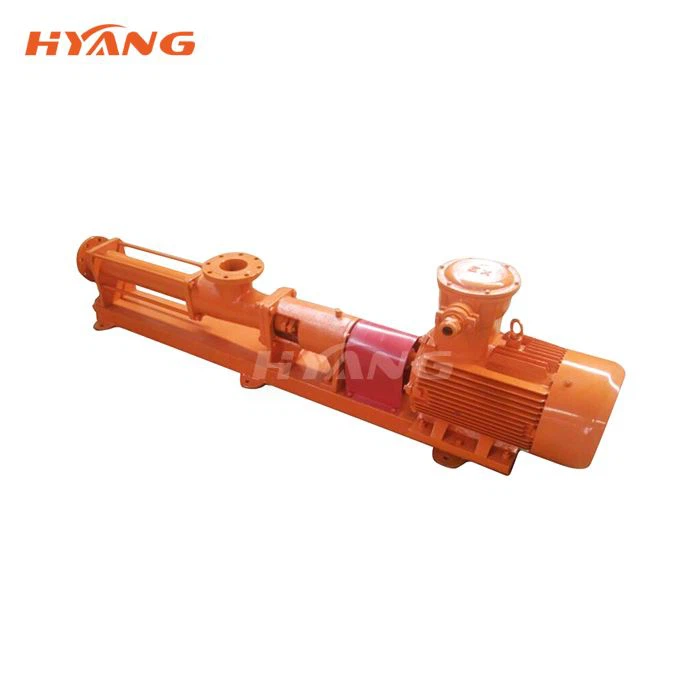
Drilling centrifugal pump mainly supplies to solids control circulating system of oilfield drill rig,and be used to provide drilling liquid with a certain discharge capacity and pressure to sand, desilter and mud mixer,to assure these equipments work efficiently.
Company Profile
Xi'an Huayang Oil & Gas Equipment Co., Ltd. (HYANG) was established in January of 2017, we are a professional manufacturer of oilfield solid control equipment and oilfield integrated engineering service provider. HYANG has an outstanding team of 30 R&D personnel, 18 management staff, 20 domestic and overseas marketing specialists plus 15 after-sales services, together with advanced equipment, strong technology, excellent product design, and research ability. Our products comply with API standards and have passed the ISO9001 quality management system. They have been adopted by major oil fields in domestic and overseas.
Why Choose Us
Experienced team
HYANG has an outstanding team of 30 R&D personnel, 18 management staff, 20 domestic and overseas marketing specialists plus 15 after-sales services, together with advanced equipment, strong technology, excellent product design, and research ability.
Our product
HYANG mainly works for various solids control equipment and accessories, solids control system, Oil sludge treatment, vacuum absorption environmental toilet, and also mud recycling system used in HDD, TMB, CBM, and boring pipe. And oilfield equipment, energy-saving, and environmental protection products like drilling rig equipment, drilling rig accessories, wellhead devices, high-presifoldsure men, well completion/testing tools.
Quality control
Our products comply with API standards and have passed the ISO9001 quality management system. They have been adopted by major oil fields in domestic and overseas.
Our service
HYANG always persists in the business philosophy of customer-focused service ideas to satisfy customer needs, providing integrity and efficient package solutions for worldwide industrial manufacturers and also timely, transparent, and veritable procurement experience for customers.

Shale shaker is the primary step of the sieving. It can remove over 100um particles when drilling.Drilling rig shakers screen the drilling fluid containing a large number of cuttings, separate large-size solid particles, and send the drilling fluid to the next separation device, our HY series shale shakers have advantages like simple structure, reliable performance, large processing capacity, long service life, and easy maintenance.


Mud shale shaker is composed of feeding tank, base, screen box, vibration motor, etc. The screen box is supported on the base by six isolation springs, and three identical or different screens are installed on the working surface of the screen box.

Mud gun used to mix drilling fluid in the mud tank to prevent the drilling fluid from settling. Placed on the top of the drilling fluid circulation tank. Quantities are according to the number of mud agitator. Work as tank bottom washing tool when working with mud agitator. Three types of mud guns are available: low pressure, medium pressure and high pressure.

The steel-wood foundation, also known as the rig mat, is a plate-like equipment composed of wood and steel, and is an outdoor ground decoration equipment similar to floor tiles. It enables drilling workers to perform operations in various complex geographical conditions. For example, when the ground is wet or the land is too unstable during the rainy season, a steel-wood foundation is installed under the land-based oil rig.

Screw conveyors are available horizontal screw conveyors and inclined hopper screw conveyors, which can be used in conjunction with other transportation equipment to complete combined transportation, separate transportation, mixing, deployment, dehydration, compounding, unloading and stacking, etc., screw conveyors length can be customized according to site requirements. In oilfield and environmental protection fields, screw conveyors are mainly used for drilling fluid waste treatment and drill cuttings transportation, which is widely used in mud recycling systems and oily sludge treatment system projects.

1. Compact structure, small volume. 2. Cyclone Material: Polyurethane.
3. Color: Orange, Blue or customized. 4. Treatment capacity: 60~320m³/h (264~1408GPM). 5. Screen Type: Flat Panel. 6. Schneider or Siemens electrical components.

1. Separate the liquid from drilling cuttings effectively. 2. High chromium cast iron for discharge scraper to extend equipment lifetime. 3. Special designed high-pressure air knives can effectively prevent the basket from blocking. 4. Each replaceable part is individually balanced for future replacement. 5. Independent oil lubrication & oil tank cooling system meet high temperature needs. 6. Able to separate and dry different kinds of drilling waste.

1. Treatment Capacity:40~90㎥/h (176~396gpm). 2. Separation Point:5~7μm. 3. Drive Type:VFD,FHD,Constant speed(high speed,middle speed). 4. Bowl Material: 316 stainless steel. 5. EX Standard: ExdIIBt4 / IECEX / A-TEX.
What Is Drilling Centrifugal Pump
Drilling centrifugal pump mainly supplies to solids control circulating system of oilfield drill rig,and be used to provide drilling liquid with a certain discharge capacity and pressure to sand, desilter and mud mixer,to assure these equipments work efficiently. Mud drilling centrifugal pump adopts advanced design theory for pumping drilling fluid or industrial suspension (slurry).Drilling mud drilling centrifugal pump can pump abrasive, viscosity and corrosive liquid. We will provide customers with the best products to meet the needs of different conditions.
Advantages of Drilling Centrifugal Pump
High up-hole velocity
High pump flow (gpm) moves cuttings fast. This works well with lower viscosity muds - reducing mud expense, mixing time and creating shorter settling times.
Able to run a desander
The drilling centrifugal pump's high volume enables a desander to be operated off the pump discharge while drilling without adding a dedicated desander pump.
Easy to operate
Watch the flow, not the pressure. When flow decreases, reduce bit load. Begin drilling when flow resumes.
Smooth running
Drilling centrifugal pump without the inertia and "sway" effect piston pumps can sometimes generate while running.
As we know, drilling mud drilling centrifugal pump is processing drilling fluid with various solid particle and chemical. It is mainly suspending liquid then the pump impeller and casing should be more durable and high anticorrosive capability. Drilling centrifugal pump is the ideal equipment to provide impetus for desander, deserter and jet mud mixer. It can also be used as charge pump auxiliary perfusion for mud pump and trip pump for drilling well head. Drilling centrifugal pump is also called sand pump. We considered completely the set equipment can work in excellent condition in the process of designing parameters). Most parts can be exchanged with convenient operation and maintenance, less seal leakage, reliability, long life and others advantages.
Drilling centrifugal pump is combined with impeller and casing. Drilling fluid will be sucted from impeller side, when impeller rotates at high speed there will be centrifugal force and gain power or pressure. Then fluid flow through impeller path will produce pressure out. The drilling mud will come out under certain pressure. Drilling centrifugal pump designs have proved to be among the best for handling abrasive cements and drilling fluids. They are available in wear-resistant materials compatible with the diverse applications of the oil and gas industry. Drilling centrifugal pumps are available from a few gallons per minute to over two thousands five hundred gallons per minute.
Main Components of Drilling Centrifugal Pump
Impeller
It is a wheel inside the pump. It is on a narrow handle; aligning with an energy source causes rotation in the impeller when the pump operates. The impellers have three types: open, half-closed, or enclosed, but each serves the same purpose.
Delivery pipe
Although these pumps have many pipes, you must locate the delivery pipe. It is at the lower edge of the pump outlet. This pipe transports the water to a suitable height as it comprises a valve that manages the pump' s water flow.
Casing
Find the pipe connected to the impeller' s eye as it lifts the fluid. The end of the casing pipe has a foot valve and strainer, helping push the water upwards.
Suction pipe
One side of the pipe is joint to the impeller while the other goes inside the water tank. It touches the water and helps it move in a single direction. The suction pipe has a built-in strainer to filter out dirt, debris, and other waste components in the water.
How to Install Drilling Centrifugal Pump


Go through installation instructions
Once you get your hands on a drilling centrifugal pump, you would come across a list of the operation maintenance manual. Usually, the manual comes with the pump, but download one from the internet if it is not there. Before jumping to the installation part, read the manual thoroughly. It consists of all information about pump installation and maintenance protocols. Remember, if you don' t follow the manufacturer' s instructions rigorously, it can void the pump's warranty.
Inspect the pump
Next up, you have to inspect the pump visually to identify potential glitches. It will let you fix the technical faults beforehand, avoiding any disruptions during the installation process. You can either use the manufacturer' s inspection list or else feel free to follow this one.
Foundation & mounting
Every drilling centrifugal pump installation process starts with a solid foundation. It should be potent enough to form a 'level and rigid' support for the pump. Similarly, the bolts have to be of the right size to embed correctly into the base plate. If even one bolt seems loose, get your hands on a pipe sleeve. It is 2.5 meters bigger than the bolts, letting you align the position of bolts.
Ensure field alignment
Are you familiar with couplings? In the plumbing world, it is a tool to connect shafts with parallel or angular misalignment. During pump installation, you have to ensure it has enough spacing not to strike each other. Unfortunately, a general idea or blind guess doesn' t work here. You have to get some tools taper gauge and set of feeler gauges to check the alignment. If you are a perfectionist, mind getting a dial indicator since this the most reliable measurement tool. Once you complete the preliminary alignment, tighten the bolts evenly with adequate pressure. If you are placing it beside water well, make sure it doesn' t damage its foundation.
Join the pipes
Next up, you have to fix the unevenness in the foundation, if any. Build a form around the base plate that can contain the grout and sprinkle some water. With a solid foundation, you can start joining the pipes, but you have to be particular about it. All the piping practices directly affect the efficiency and power consumption of the pump. Hence, pay attention to every insignificant detail. Firstly, provide independent support to the suction and discharge pipe by using hangers or support blocks.
Connect wiring
Handling electrical cables and wires is not a piece of cake. Therefore, turn off the power supply and ensure motor wiring conforms to the national electrical codes. Instead of picking random wires, use adequate sizes to avoid voltage fluctuations. Likewise, connect the electrical supply from the switch to the motor and check the electrical current supply frequency. If possible, put the pump on a separate circuit or breaker protected with a manual disconnect. It eliminates all threats of electric currents and line faults.
Check rotation
At times, the rotation direction is not accurate, primarily if the pump operates backward or in reverse rotation. Thus, inspect the appropriate cycle of three motor phases before assembling the base. If the movement seems odd, interchange the lead wires until the motor starts rotating correctly. After this, install the pump by making a permanent ground connection to the unit. You can use a conductor or a grounded lead in the service panel to fix the pump.
Prime & start the pump
Before connecting the pump with a water tank or well, consider vacuum priming to suck the air. Now, you can connect with the tank but close the valve in the discharge pipe.
Begin drilling with mud rather than clear water to reduce surface wash out. Priming the drilling centrifugal pump can be done with a water injection pump. Attaching a foot valve on the suction end ensures prime being held in the pump. Centrifugals do not pump grouts as well as a piston pump. Centrifugals require a sealed housing and suction hose. Any air suction will greatly reduce pump efficiency. Sticky clays will stall a drilling centrifugal pump's flow. Be prepared to reduce your bit load in these conditions and increase your rpm if conditions allow. Yes, clays can be drilled with a drilling centrifugal pump. Drilling centrifugal pumps cannot pump muds over 9.5 lbs./gal. Drilling centrifugal pumps work best with a 9.0 lbs./gal. Mud weight or less. High flow rate move cuttings, not heavy mud. Drilling centrifugal pumps perform best in a vertical position with the intake as low to the ground as possible.
Explore the Main Applications of Drilling Centrifugal Pump in the Drilling Mud Industry
The drilling mud industry plays a vital role in the extraction of natural resources such as oil and natural gas. In order to mine these resources effectively, the right equipment and machinery must be used. One of the essential equipment in the drilling mud industry is the sand pump. Sand pumps are specifically designed to transport abrasive fluids and are critical to the success of drilling operations.
One of the primary applications of sand pumps in the drilling mud industry is to remove drill cuttings from wellbores. During the drilling process, large amounts of solid material such as sand, rock, and debris are produced. These cuttings need to be removed from the wellbore to ensure smooth operation of the drilling rig. Sand pumps are used to transport these cuttings from the wellbore to the surface, where they are properly disposed of. Another important application of sand pumps in the drilling mud industry is the circulation of drilling mud. Drilling mud, also known as drilling fluid, is an important part of the drilling process. It helps cool and lubricate the drill bit, bring cuttings to the surface, and maintain wellbore stability. Sand pumps are used to circulate drilling mud throughout the drilling operation, ensuring that it is free of solid particles and contaminants.
Additionally, sand pumps are used to mix and distribute drilling mud additives. To optimize the performance of drilling mud, various additives such as polymers, chemicals and viscosifiers are often added to the mud. Sand pumps play a key role in the thorough mixing and mixing of these additives, ensuring that the drilling mud has the properties required for efficient drilling operations. Sand pumps are indispensable in the drilling mud industry and play a vital role in various applications such as removing drill cuttings, circulating drilling mud, and mixing drilling mud additives. Their ability to handle abrasive fluids is critical to the success of drilling operations, making them important equipment in the industry.
Xi'an Huayang Oil & Gas Equipment Co., Ltd. (HYANG) was established in January of 2017, we are a professional manufacturer of oilfield solid control equipment and oilfield integrated engineering service provider. HYANG has an outstanding team of 30 R&D personnel, 18 management staff, 20 domestic and overseas marketing specialists plus 15 after-sales services, together with advanced equipment, strong technology, excellent product design, and research ability. Our products comply with API standards and have passed the ISO9001 quality management system. They have been adopted by major oil fields in domestic and overseas. HYANG mainly works for various solids control equipment and accessories, solids control system, Oil sludge treatment, vacuum absorption environmental toilet, and also mud recycling system used in HDD, TMB, CBM, and boring pipe. And oilfield equipment, energy-saving, and environmental protection products like drilling rig equipment, drilling rig accessories, wellhead devices, high-presifoldsure men, well completion/testing tools, Our products have been exported to more than 30 countries, such as Russia, Saudi Arabia, Indonesia, Kuwait, Iran, Algeria, Nigeria, Argentina, Australia, etc.


Our Certificate


FAQ
Hot Tags: drilling centrifugal pump, China, suppliers, manufacturers, factory, customized, buy, price, pricelist, quotation, for sale
Send Inquiry
